AI
The .si Domain Rush Is Real. The Rename Behind It Is Narrow
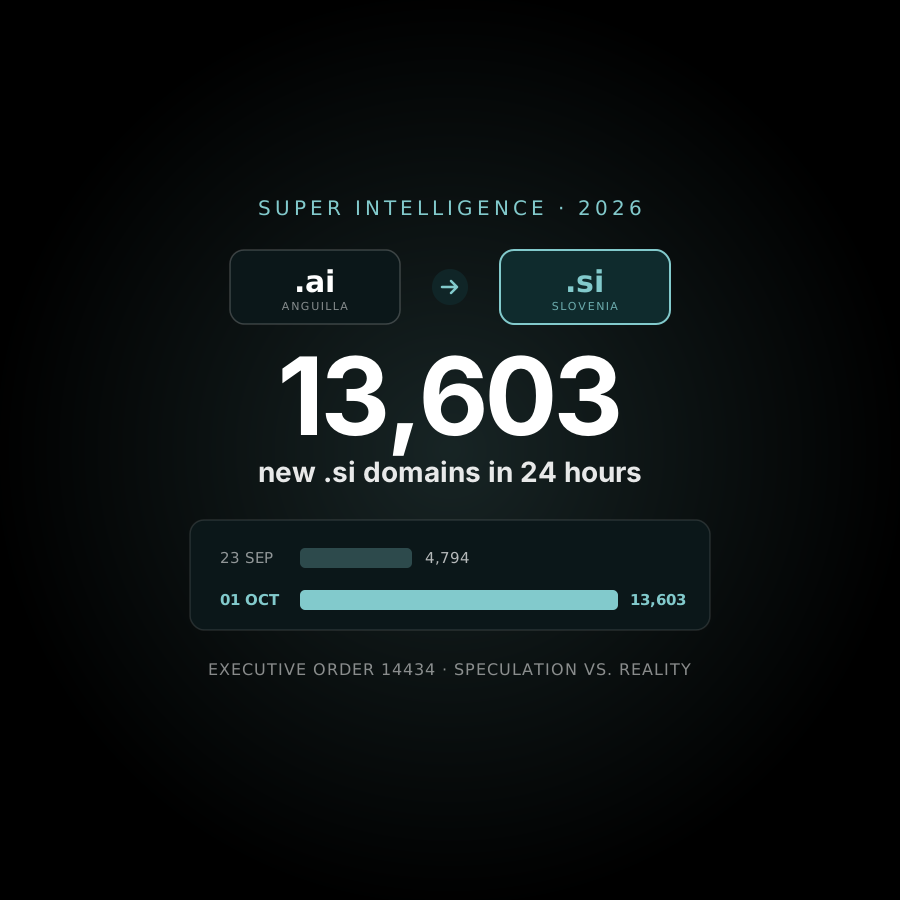
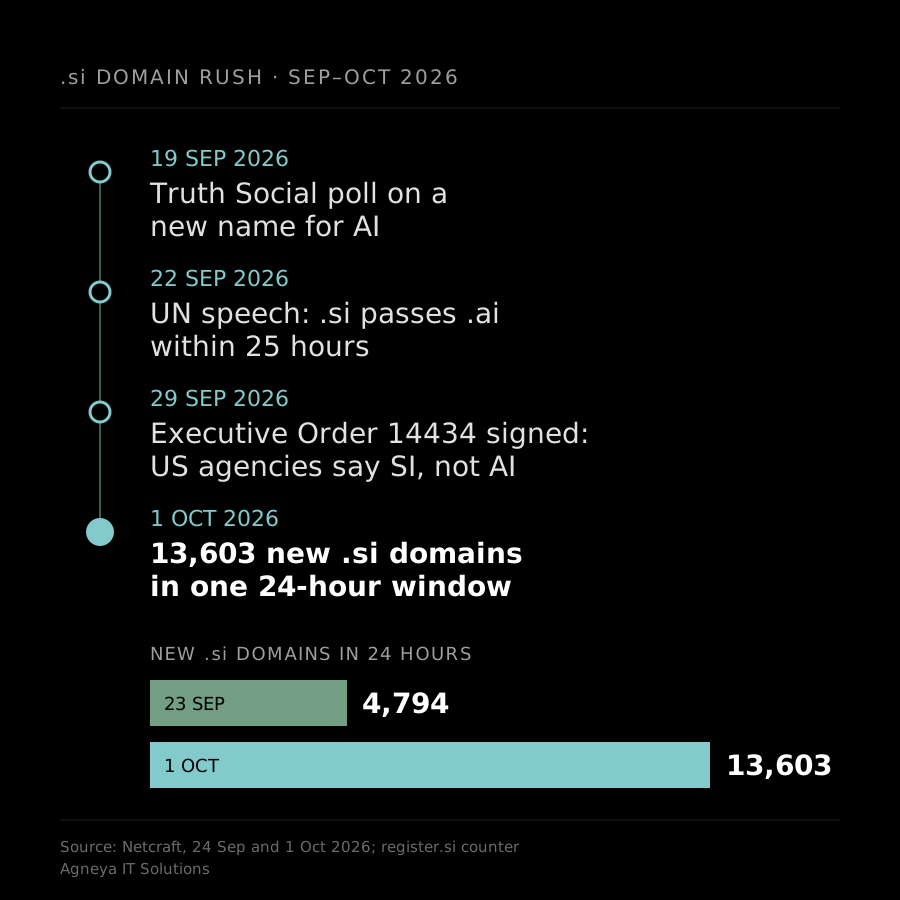
Netcraft, reading Slovenia’s registry counter, saw 3,515 new .si domains for the previous month on 23 September, then 13,603 in a single 24-hour window on 1 October. The trigger was a change in what the US federal government is told to call AI. The .si domain now reads as shorthand for Super Intelligence, and much of the buying so far looks speculative. The order behind it covers far less than the headlines suggest.
The Short Answer
The .si domain is Slovenia’s country-code domain, and it is trending because Executive Order 14434 tells US federal agencies to write Super Intelligence and SI in place of Artificial Intelligence and AI. The order governs executive-branch documents, not companies, other countries or the domain system. Nothing has made .si the official home of AI. Registrants are betting that SI catches on as shorthand the way .ai did, and that bet is still untested.
That holds until you look at who is buying. Netcraft found that about 52% of the .si domains registered at one registrar between a Truth Social poll on 19 September and the UN speech on 22 September were already listed for resale by 23 September. The part that costs money is the lookalike risk, because a .si address sits one keystroke away from its .ai twin. Our AI and security services cover that kind of exposure, but the checks below cost almost nothing.
What is the .si domain, and what happened to it?
.si is Slovenia’s country-code top-level domain, an address ending that anyone can register, not only Slovenian people or entities. It matters now because SI is the abbreviation the US executive branch has been ordered to use. Netcraft’s 24 September analysis found .si registrations overtook .ai, Anguilla’s domain, in the 25 hours after the UN speech.
The sequence was short. President Trump shared a poll about a new name for AI on 19 September, told the UN General Assembly on 22 September that the US would call AI super intelligence, and signed the order on 29 September. Netcraft’s data shows the first spike beginning roughly three days before the speech. That suggests some buyers were speculating on a rename in advance, although Netcraft says it cannot tell whether they were acting on anticipation or on unrelated factors.
After the order, daily registrations more than doubled compared with the week between the speech and the order, according to Netcraft’s 1 October update. Much of that acceleration came through OpusDNS, a registrar that launched in October 2025 and appears to have added .si support on 23 September. Netcraft also notes that .si publishes no zone files, so its hourly counts rest on its own internet survey data. Other outlets quote different windows and totals, so compare figures only when the date and the counter match.
What does Executive Order 14434 change?
Executive Order 14434 changes the vocabulary of the US executive branch and starts a legal clean-up, not a rename of the technology. Signed on 29 September 2026 and printed in the Federal Register on 2 October, it directs executive departments and agencies to use Super Intelligence and SI in place of Artificial Intelligence and AI in official correspondence, public communications, websites, reports and other non-statutory documents, to the maximum extent permitted by law.
A rename inside US federal documents is not a rename of the internet.
The order does not rewrite the law. For its own purposes, the new terms mean the technologies covered by the existing statutory definition of artificial intelligence in section 9401(3) of title 15 of the United States Code. The IAPP reports that the order does not itself replace that definition and that, within 60 days, the assistant to the president for science and technology must submit proposed legislative language on a federal definition and on changes to existing statutory references.
| Question | What the sources say | Source |
|---|---|---|
| Who must use the new terms? | Executive departments and agencies, to the maximum extent permitted by law | Executive Order 14434, section 2 |
| In which documents? | Official correspondence, public communications, websites, reports, policy documents and other non-statutory documents | Executive Order 14434, section 2 |
| What does Super Intelligence mean? | The technologies covered by the statutory definition of AI in 15 U.S.C. 9401(3) | Executive Order 14434, section 3 |
| Is the statute rewritten? | No. Existing legal definitions are unchanged for now; proposed legislative language is due within 60 days | IAPP, 30 September 2026 |
Who is buying .si names, and why does it matter?
Mostly speculators, on the evidence so far. Netcraft traced just over half of one registrar’s early .si registrations to resale listings, and CircleID reports that Domain Name Wire found little sign of companies adopting .si as an operating identity. Domain speculation is the buying of names in the hope that someone later pays more for them.
Netcraft also counted more than 44,000 .si names that match an existing .ai name letter for letter, which was 22% of all .si domains in its count. About 1,500 of those pairs resolved to the same IP address, though many are parked or for sale, where a shared address does not imply common ownership. Outside .si, two batches totalling 87 .com domains that pair well-known brand names with the word superintelligence were registered on 29 September, before the order was signed. Each is listed at $20,000, and Netcraft had seen no change of ownership.
| Date | Figure | Scope and caveat | Source |
|---|---|---|---|
| 22 Sep 2026 | .si registrations overtook .ai | Within 25 hours of the UN speech; Netcraft survey data | Netcraft, 24 Sep 2026 |
| 23 Sep 2026 | 4,794 new .si domains in 24 hours; 3,515 in the previous month; 198,535 in total | register.si counter as read by Netcraft; “previous month” is Netcraft’s presumed reading | Netcraft, 1 Oct 2026 |
| 23 Sep 2026 | Approximately 52% of .si domains registered at Dynadot between the poll and the speech were listed for resale | One registrar only; sample size not stated | Netcraft, 24 Sep 2026 |
| 24 Sep 2026 | .si about $11 for one year; .ai about $180 for the minimum two-year term | Netcraft’s price check on that date; prices vary by registrar | Netcraft, 24 Sep 2026 |
| 29 Sep 2026 | 87 .com brand-plus-superintelligence domains registered, each listed at $20,000 | Two batches at one registrar; no ownership change seen | Netcraft, 1 Oct 2026 |
| 1 Oct 2026 | 13,603 new .si domains in 24 hours | register.si counter as read by Netcraft | Netcraft, 1 Oct 2026 |
Why a one-key typo matters
On a QWERTY keyboard the s sits next to the a, so a .si address is a one-keystroke typo of its .ai equivalent. Netcraft notes that criminals could register .si lookalikes of legitimate .ai sites, a tactic known as typosquatting. Cybersquatting, where someone registers a name matching your brand to sell it back to you, is the second risk.
Both remain forecasts. Netcraft saw a low level of fraud on .si on 24 September, and on 1 October it had yet to see a rise in malicious content such as phishing tied to the rename. Brand protection here means watching for a problem before it arrives, not reacting to one.
Should your business register a .si name?
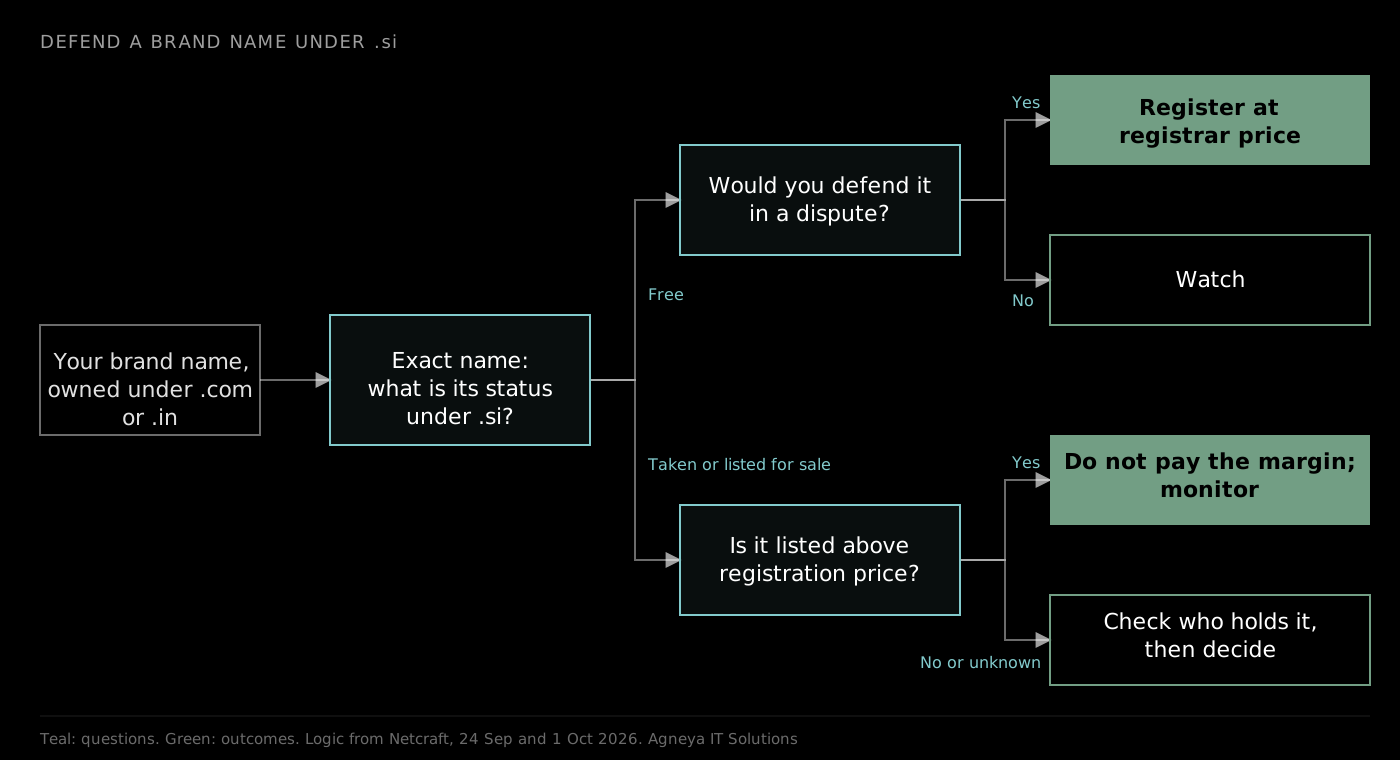
Only if you would defend the name anyway, not because the rename might stick. Euronews reports that Register.si, the Slovenian registry, advised holders of trademarks, slogans and company names without a .si domain to register one as soon as possible. Treat that as brand defence with a known cost, not as a growth move.
The cost is low at registrar prices. Netcraft put .si at about $11 for one year on 24 September. Aftermarket listings are different: Netcraft saw them priced above what the same names would cost unregistered, so buying a listed name pays the speculator’s margin. The decision that matters is per name, since a main brand name and a campaign slogan carry different risk.
Where this does not apply
No source retrieved for this post measures whether customers will ever type a .si address, or whether SI will spread beyond US federal documents. If someone else already holds your exact name under .si, registering your own will not help, because that is a dispute and not a purchase.
What should developers and AI teams check?
Nothing in Executive Order 14434 changes a model, an API or a library; it changes wording in federal documents. The IAPP calls the immediate change linguistic and says it creates a terminology challenge for governance programmes, because existing legal definitions stay as they are. Check your documents, your search terms and your lookalike exposure.
If you sell to US federal buyers, their documents may say SI while the statute still says AI until the 60-day proposal lands. Mapping both terms in your compliance documentation keeps the two readings consistent. The retrieval and architecture choices in our hybrid retrieval query routing post do not depend on which name the technology carries. Netcraft had not found any .gov hostnames referring to super intelligence as of 1 October, so agency websites had not yet visibly switched.
Where to start: six checks this week
- List every domain you own across .com, .in, .ai and any others. Output: one inventory with registrar and renewal date.
- Check your exact brand name under .si at your registrar. Output: a list of names that are free, taken or listed for sale.
- Decide each name: defend, ignore or watch. Output: one decision and one owner per name.
- Register the names you chose to defend at registrar price, and skip aftermarket listings priced above it. Output: renewal dates added to your inventory.
- Add .si lookalikes of your .ai and .com domains to brand monitoring and mail filtering. Output: a monitored list that someone reviews on a schedule.
- Review again once the 60-day legislative proposal is published. Output: a dated note on whether US federal wording has changed.
Questions about the Super Intelligence rename
Is .si now the official domain for AI?
No. .si is Slovenia’s country-code domain, and Netcraft notes that anyone can register one. Executive Order 14434 sets wording for US executive-branch documents. It does not designate a domain for AI or change who runs .si.
Does the order apply to private companies?
Its text addresses executive departments and agencies, and the IAPP describes the immediate change as linguistic. Watch the 60-day proposal on legislative language, because that is where any change to statutory wording would first appear.
Is a .si domain cheaper than a .ai domain?
On 24 September Netcraft priced .si at about $11 for one year and .ai at about $180 for its minimum two-year registration. Prices vary by registrar and can move quickly during a rush, so check the current price before you decide.
Will SI replace AI as the standard term?
That is not settled. The order covers US executive-branch documents only, and the statutory definition of AI in US law stays in place for now. Whether industry, other governments or the public adopt SI is something none of the sources retrieved for this post can answer.
Can a .si lookalike be used for phishing?
In principle, yes. Netcraft notes that a .si address is a one-keystroke typo of its .ai equivalent. As of 1 October it had not yet seen a rise in malicious content such as phishing tied to the rename, so treat it as a risk to monitor.
Defend the name, skip the hype
The .si domain rush is a real market reacting to a narrow rule. The order changes how US federal agencies write, the speculation is measurable, and the lookalike risk is a forecast with a cheap defence. None of it proves that SI will replace AI outside federal paperwork.
This week, list your names, check each one under .si and decide which you would defend. Skipping that check leaves the cheapest moment to act, while names are still unregistered, to someone else.
The Agneya perspective
Agneya IT Solutions is a software studio in Surat, Gujarat, India. Six disciplines under one roof: design, engineering, cloud, security, AI and growth.
If you want a second view on which names to defend, send us your domain list and your brand names, and we will return a defend, ignore or watch call on each.
Sources & References
- The White House, “Inaugurating the Era of Super Intelligence”, Executive Order 14434, 29 September 2026. Also printed in the Federal Register, Vol. 91, No. 190, 2 October 2026, page 63129 (PDF copy).
- Netcraft, “Slovenian .SI Domain Registrations Outpace .AI After Trump’s ‘Super Intelligence’ AI Rename”, 24 September 2026.
- Netcraft, “‘Super Intelligence’ Executive Order Fuels Nearly Hundredfold Increase in .si Domain Registrations”, 1 October 2026.
- IAPP, “AI by any other name? White House directs federal agencies to enter the era of ‘super intelligence’”, 30 September 2026.
- Euronews, “Trump’s AI rebrand sparks unexpected rush for Slovenian .si domains”, 29 September 2026.
- CircleID, “.si Registrations Surge After US Shift to ‘Super Intelligence’”, reporting Domain Name Wire’s findings.