Security
eMudhra certificate compromise: when the key was the number 4
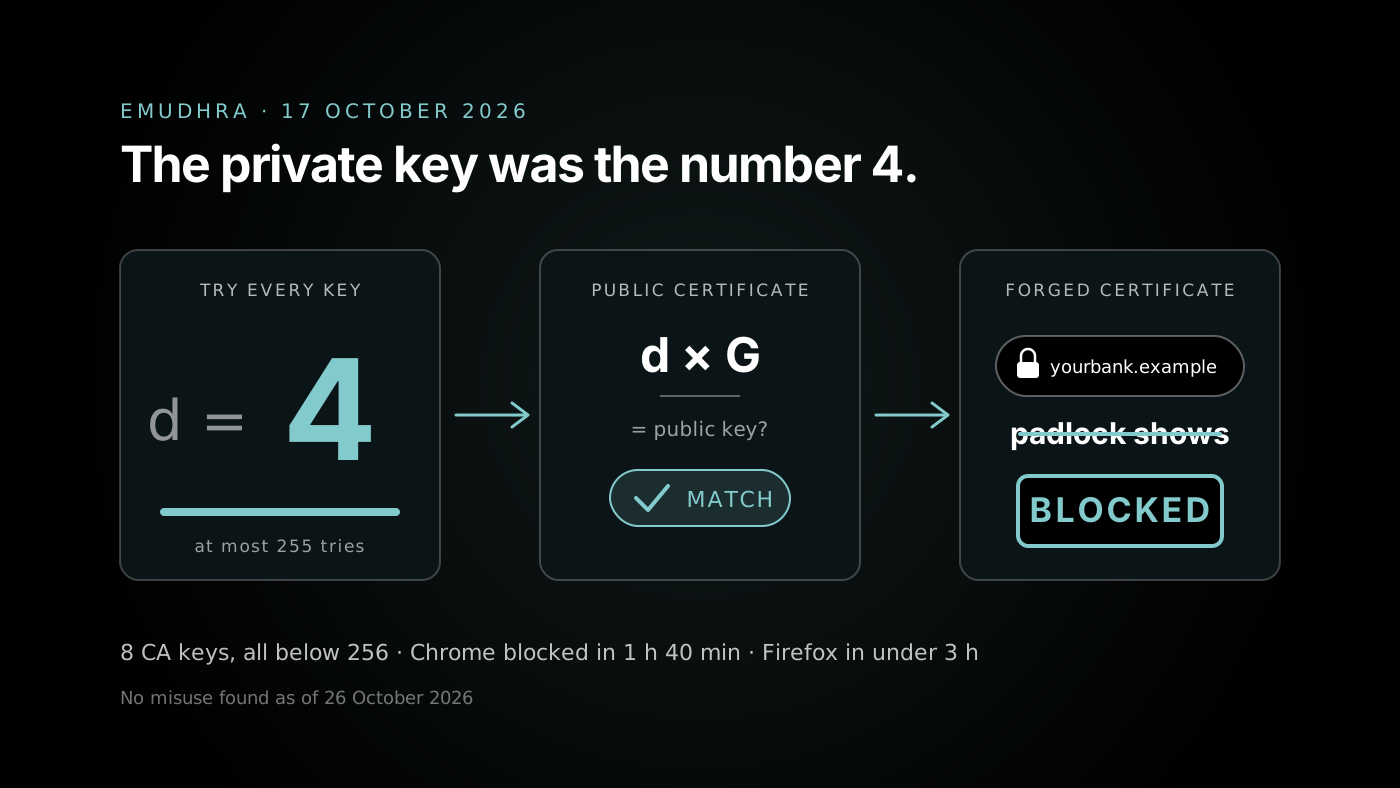
One of the secret keys behind eMudhra’s website certificates was the number 4. Not a 4 buried in a long random string. Just 4.
The eMudhra certificate compromise was a key-generation mistake, not a break-in. Eight intermediate certificates that the Indian certificate authority had placed in every major browser’s trust list had private keys smaller than 256, so anyone could work them out from public data. Chrome and Firefox blocked them within hours of the report on 17 October 2026, and as of 26 October nobody has found evidence that the keys were used.
The browsers were the easy part. Software that checks certificates without a browser’s update channel, like a script calling a payment API, a build pipeline or a device on a factory floor, kept trusting those keys after Chrome and Firefox had moved on. That’s where the clean-up actually is.
What happened in the eMudhra certificate compromise?
On 30 April 2025, eMudhra created eight intermediate certificate authorities under its emSign ECC Root CA - G3 in a key generation ceremony. Six could issue website (TLS) certificates and two could issue code-signing certificates. According to Scott Helme’s analysis, each one was also cross-signed by Sectigo’s AAA Certificate Services root in May 2025.
eMudhra’s account, in its 21 October filing to the stock exchanges, is that a wrap/unwrap step in the ceremony produced a second, weak set of keys alongside the strong ones, and the weak ones were the ones published to browser root stores. The company says the keys sat on FIPS 140-2 Level 3 hardware security modules and that it’s still establishing the root cause. Its incident page adds that seven of the eight were never used in production and the eighth hadn’t issued a single certificate.
On Saturday 17 October, a researcher reported the weak keys to Apple, Google, Microsoft, Mozilla and eMudhra. Five days later, on 22 October, eMudhra’s board decided to leave the global SSL/TLS certificate business, which the company says brings in about 1% of its revenue.
How can a private key be the number 4?
It can’t, if the key was made properly. These were elliptic-curve keys on the P-384 curve, and as Helme puts it, “a P-384 private key should be a random 384-bit number.” That’s a number around 116 digits long. The public key in the certificate is that number multiplied by a fixed point on the curve, called G. Going backwards from a public key to a properly random private key isn’t practical with any computer that exists.
Going backwards from a tiny key is trivial. Compute 1 × G, then 2 × G, then 3 × G, and compare each with the public key in the certificate. With every key below 256, that’s at most 255 tries. Helme recovered all eight keys from the public certificates in less than a second on his laptop. He published values including 4, 56 and 115, and wrote that an AI agent repeated the job from a single prompt. BleepingComputer independently checked that a published key matched one of the revoked certificates.
The hardware was certified and the audits had passed. The number that mattered was 4.
How fast did Chrome and Firefox block eMudhra?
Chrome had the keys blocked one hour and forty minutes after it got the report. Firefox took under three hours. Neither needed users to update or restart anything, because both browsers push certificate block lists in the background.
| When (UTC) | What happened |
|---|---|
| 17 Oct, 18:05 | Google’s Chrome Root Program receives the report |
| 17 Oct, 19:45 | Chrome pushes a CRLSet update blocking the eight keys |
| 17 Oct, 20:06 | Mozilla receives the report |
| 17 Oct, 22:59 | Firefox’s OneCRL block reaches every user on standard settings |
| 19 Oct | Apple blocks the certificates; Android and Googlebooks get Chrome’s protection through Google Play Services |
| 20 Oct | Microsoft blocks them; Mozilla ships NSS 3.131.1, removing the emSign ECC Root CA - G3 from its trust list |
| 21 Oct | CERT-In issues an advisory; eMudhra files its statement with NSE and BSE |
| 22 Oct | eMudhra announces its exit from the global SSL/TLS business |
| 27 Oct (scheduled) | Chrome removes the emSign ECC Root CA - G3 from the Chrome Root Store |
Times for Chrome and Android are from Google’s 20 October security post, Firefox times from Mozilla’s post the same day, and the Apple and Microsoft dates from ThePrint’s explainer.
Does the HTTPS padlock still mean a site is safe?
The padlock means two things: your connection is encrypted, and the site’s certificate traces back to a certificate authority your device trusts. It doesn’t mean the site is honest, and it’s only as strong as every authority on that list. A trusted authority’s key in the wrong hands can make a valid-looking certificate for any domain, your bank’s included.
Using one still takes more than the key. Mozilla notes an attacker would also need to intercept your connection, for example on a hostile Wi-Fi network, to impersonate a site and read or change what you send. Chrome adds another layer: it only trusts certificates that are publicly logged in Certificate Transparency, and Google says no website certificate from these six TLS intermediates had been logged before the block. A forged certificate that skipped the logs wouldn’t have worked in Chrome by default.
Are eMudhra DSC and eSign affected?
No. eMudhra says its Indian Digital Signature Certificate (DSC) and eSign services run on completely separate infrastructure from the global TLS business, and are working normally. The Ministry of Electronics and IT said the same: MeitY said, as Business Today reported, that the impact on Indian websites and applications was “very limited and for a very short interval”, and set up a team to investigate.
So if you use an eMudhra DSC token for income tax filing, EPF or e-tenders, there’s nothing to do. CERT-In, India’s computer emergency response team, said it “did not see any malicious use” of the keys as of 21 October.
Who is still exposed after the browser fix?
Anything that checks certificates against a file of trusted roots on disk and never asks whether a certificate was revoked. Helme tested this: curl, Python and Node all accepted a certificate for api.stripe.com issued from one of these intermediates, with default settings. Windows CryptoAPI accepted it too, unless revocation checking was switched on.
That covers a lot of quiet software: install scripts that pipe curl into a shell, CI/CD pipelines, server-to-server API calls, containers built months ago, and IoT or embedded devices. Helme points out that a device with a frozen certificate bundle will keep trusting these intermediates until they expire in July 2039. And because each one was also cross-signed by Sectigo’s root, a client can reach a root it trusts without going through eMudhra’s root at all.
Fixes are out. Go, Node.js, Python’s certifi bundle and several Linux distributions shipped updates, CyberScoop reported. They only help once they’re installed, and once whatever was built on them is rebuilt.
What should you do now?
This is our advice, drawn from the vendor posts above.
| Who | What to do |
|---|---|
| Everyone | Update your browser and phone. On Android, Google says a restart pulls the fix straight away. Never click past a certificate warning, which CERT-In also asked users not to do. |
| Businesses with an emSign certificate | Check whether your site’s certificate chains to the emSign ECC Root CA - G3. If it does, Google says to install a replacement from another hierarchy now: Chrome stops trusting that root on 27 October. eMudhra says it’s replacing affected certificates at no cost. |
| Businesses buying software or devices | Ask each vendor where their product keeps its trusted certificate list and how it gets updated. A device that can’t be updated keeps trusting these keys until 2039. |
| Developers and ops | Update everything that ships a certificate bundle: the OS ca-certificates package, certifi, Node, Go, Homebrew. Rebuild container images once their base images update. Where your client can check revocation, switch it on. |
To see who issued your own site’s certificate chain, run this with your domain:
openssl s_client -connect yourdomain.com:443 -showcerts </dev/null 2>/dev/null | grep -i issuerIf emSign or eMudhra appears, talk to whoever manages your certificates this week.
What this post doesn’t cover
The root cause. eMudhra has promised a full root-cause report to the browser root programs, and until it’s out, nobody outside the company can say exactly how a hardware security module ended up holding a one-byte key. This post also isn’t investment advice on eMudhra’s shares, and it doesn’t cover the company’s other roots, which Google says it’s still reviewing.
The Agneya perspective
Nothing here was exotic. The hardware was certified and the audits had passed. One step in a procedure produced the wrong output, and nobody tested that output before it went into every browser in the world. A check that tries the first few thousand values against a new public key takes milliseconds to run.
It’s the same pattern as the Bitget hack: the strong part held, and the step around it failed. A padlock is only as safe as the work behind it. For the systems we build, that means knowing every place a certificate gets trusted, not only the browser, and keeping each of those places updated. It’s the same question as the dependencies check in our code audit: is this still getting security updates?
If your servers, containers or devices make HTTPS calls on their own, we can help you find every certificate bundle in them and keep them current. Tell us what you need.
Sources
- Scott Helme, “Eight Bits of Trust; eMudhra’s CA keys cracked in milliseconds”, 20 October 2026.
- Google, “Protecting Chrome and Android users from compromised eMudhra intermediate CA certificates”, 20 October 2026.
- Mozilla Security Blog, “Protecting Firefox users following the compromise of eMudhra intermediate certificates”, 20 October 2026.
- eMudhra, “eMudhra statement on recent certificate security incident”, 20 October 2026, updated 26 October 2026.
- eMudhra Limited, filing to NSE and BSE, “eMudhra statement on distrust of select Global TLS intermediate and one root CA”, 21 October 2026.
- eMudhra, “eMudhra to exit global SSL/TLS certificate business”, 22 October 2026.
- BleepingComputer, “Mozilla, Google, Apple block compromised eMudhra CA certificates”, October 2026.
- CyberScoop, “eMudhra kills its certificate business after researchers cracked its private keys in under a second”, 22 October 2026.
- ThePrint, “What’s the eMudhra security scare that has rattled the internet? All you need to know”, 21 October 2026.
- Business Today, “‘Impact has been very limited’: MeitY on eMudhra security incident, says Indian DSC and eSign unaffected”, 21 October 2026.